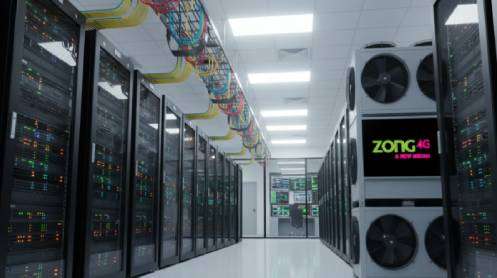
ISLAMABAD: China Mobile Pakistan (CMPak), operating under the brand name Zong, has called for the application of industrial electricity tariffs for its Cloud and Integrated Data Centre (IDC) facilities, warning that high energy costs are undermining the competitiveness of local data centres and discouraging international cloud service providers from localising infrastructure in Pakistan.
In a letter addressed to Secretary Ministry of IT and Telecommunication (MoITT) Zarrar Hasham Khan, with copies sent to the Chairman NEPRA, Secretary Power Division, and Secretary SIFC, Shahid Razzaque, Director Regulatory Affairs at CMPak, said the company has long operated as a licensed telecommunications operator in Pakistan, making significant investments in nationwide connectivity and digital inclusion.
He noted that, in line with the government’s Digital Pakistan vision, CMPak has strategically diversified into emerging digital infrastructure segments, particularly cloud services and integrated data centres. As part of this expansion, the company has established a Tier-III rated data centre at its headquarters in Chak Shahzad, Islamabad, representing a substantial capital investment and a long-term commitment to Pakistan’s digital ecosystem. CMPak also plans to develop similar Cloud and IDC facilities in Lahore and Karachi to support government digitalisation, local content hosting, data sovereignty and enterprise-grade cloud services.
However, while participating in government tenders for cloud, hosting and data centre services, CMPak faces what it terms a structural competitive disadvantage. Companies incorporated as IT firms or operating within Special Technology Zones (STZs) benefit from extensive fiscal incentives, including tax holidays, rebates and customs exemptions under the Special Technology Zones Authority (STZA) framework.
As a telecom operator, CMPak is currently ineligible for STZ inclusion, as telecom companies are excluded from obtaining Zone Developer (ZD) or Zone Enterprise (ZE) licences under existing policies. This, the company argues, creates an uneven playing field, despite CMPak offering identical cloud and IDC services, deploying comparable technologies and competing for the same government projects.
As a result, CMPak’s bids are often less competitive on cost—not due to inefficiency, but because it lacks the fiscal incentives available to similarly placed service providers.
The company has urged policymakers to treat Cloud and IDC businesses based on the nature of services provided, rather than the legacy licensing category of the parent company. It emphasised that its Cloud and IDC operations are distinct from core telecom services and are fully aligned with national priorities, including promoting data sovereignty, enabling e-government platforms, developing indigenous cloud infrastructure, attracting foreign investment, and creating high-value IT and digital jobs.
CMPak has therefore requested MoITT’s support in developing a policy mechanism that grants fiscal parity to telecom operators engaged in Cloud and IDC businesses. This would include tax exemptions or incentives equivalent to those available to IT companies and STZ-based enterprises, at least for their Cloud and IDC verticals, to ensure fair competition and accelerate digital infrastructure growth.
The company has also highlighted the critical issue of electricity tariffs. Data centres are energy-intensive facilities, and electricity costs are a decisive factor in their commercial viability. Although the telecom sector has been officially declared an industry, telecom operators have so far been unable to benefit from industrial electricity tariffs, with the issue remaining entangled in litigation with NEPRA for several years.
Without access to industrial power tariffs, CMPak warned, Pakistan’s IT and cloud ecosystem would struggle to scale sustainably. High energy costs not only erode the competitiveness of local data centres but also discourage global cloud providers from investing and localising infrastructure in the country.
In this context, CMPak has urged MoITT to advocate for the application of industrial electricity tariffs for Cloud and IDC operators and to champion fiscal and regulatory support for Cloud and IDC infrastructure as a strategic national asset for Pakistan’s digital economy.
“We firmly believe that timely policy intervention and fiscal support will enable telecom operators like CMPak to make further investments, support government digital initiatives, and contribute meaningfully to Pakistan’s IT exports and digital resilience,” Shahid Razzaque said.
Story by Mushtaq Ghumman